GEOTECHNICAL ENGINEERING
STOKE-ON-TRENT
HomeLaboratoryLaboratory CBR test

Laboratory CBR Testing in Stoke-on-Trent: Subgrade Strength for Road & Pavement Design

Practical geotechnics, field-tested.

LEARN MORE

The variable ground across the Potteries, from glacial till to weathered mudstone, means subgrade strength can shift dramatically between two boreholes on the same site in Stoke-on-Trent. We run laboratory CBR tests because a pavement designed on an assumed 5% CBR that encounters a real 2% subgrade will fail within the first winter. The combination of Stoke-on-Trent's damp climate and clay-rich drift deposits makes soaked CBR testing mandatory under BS 1377-4, and our lab processes specimens under controlled moisture conditions to replicate the worst-case scenario the subgrade will face after construction. Before finalising the pavement layers, many schemes in Stoke-on-Trent start with a grain-size analysis to confirm the fines content driving the saturation behaviour.

A 2% CBR subgrade needs roughly twice the granular layer thickness of a 5% CBR — the test pays for itself in the pavement section alone.
Our service areas

Methodology and scope

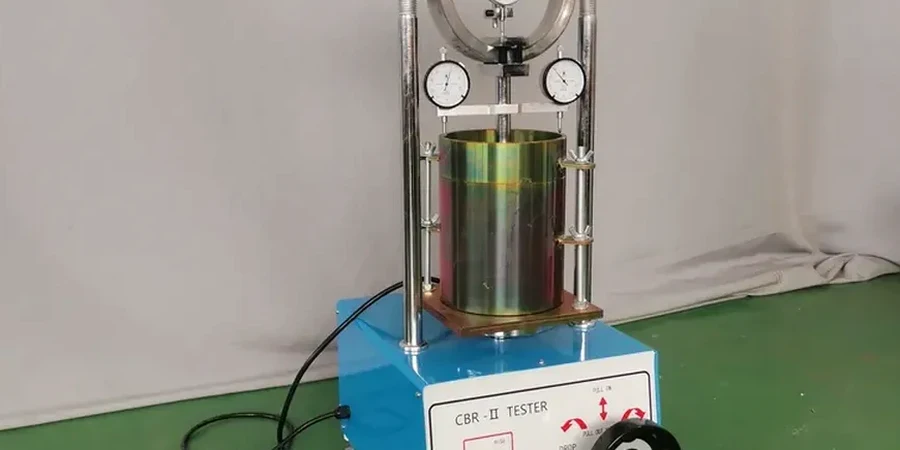
A recent industrial access road near Etruria sat on a band of laminated clay that looked firm in the trial pit but turned soft once the saturation curve kicked in during the remoulded CBR test. That is exactly why Section 3 of the Manual of Contract Documents for Highway Works (MCHW) demands laboratory CBR values on remoulded specimens compacted to the specified dry density. In Stoke-on-Trent our procedure follows BS 1377-4: three-point compaction to determine the moisture-density relationship, then a 96-hour soak under a 4.5 kg surcharge load before penetration with the 49 mm plunger at 1.27 mm/min. The force readings at 2.5 mm and 5.0 mm penetration are plotted against the standard California aggregate curve, and we report the lower of the two percentages as the design CBR. On sites where the natural ground shows marginal values below 2%, we often recommend correlating the results with a cbr-road field test to verify the compaction response under actual site plant and moisture conditions.
Laboratory CBR Testing in Stoke-on-Trent: Subgrade Strength for Road & Pavement Design
Technical reference — Stoke-on-Trent

Local geotechnical context

Stoke-on-Trent sits at elevations ranging from 90 m in the Trent valley to over 200 m on the ridge towards Kidsgrove, and that topography creates perched water tables in the drift deposits that saturate the subgrade seasonally. If the laboratory CBR is determined only on unsoaked specimens, the designer gets a false picture of summer strength that disappears with the first autumn rain. The risk is pavement rutting, edge cracking, and premature potholing on housing estate roads, logistics yards, and the link roads feeding the A500. We insist on the soaked procedure because the 96-hour immersion directly models the effect of a wet winter on the compacted formation in Stoke-on-Trent, and the swell percentage we record during the test tells the engineer whether the clay fraction will heave and lift the bound layers.

Need a geotechnical assessment?

Reply within 24h.

Email: contact@geotechnical-engineering.biz

Reference standards

BS 1377-4:1990 — Soaked and unsoaked CBR laboratory test, Manual of Contract Documents for Highway Works (MCHW), Volume 1, Series 600, BS EN 1997-2:2007 (Eurocode 7) — Ground investigation and testing

Technical data

ParameterTypical value
StandardBS 1377-4:1990, Clause 7
Specimen compaction2.5 kg rammer or 4.5 kg rammer, 5 layers
Soaking period96 hours under 4.5 kg surcharge
Penetration rate1.27 mm/min
Key values reportedCBR at 2.5 mm and 5.0 mm penetration
Typical Stoke subgrade range2% – 8% (glacial till and mudstone)
Swell measurementDuring soaking, via dial gauge on surcharge plate

Frequently asked questions

What is the difference between soaked and unsoaked CBR?

Soaked CBR measures the strength after the specimen has been submerged for 96 hours under a surcharge load, simulating the worst-case wet condition of the subgrade. Unsoaked CBR is measured at the as-compacted moisture content. BS 1377-4 and MCHW Series 600 require the soaked value for pavement design in the UK, because subgrades in areas like Stoke-on-Trent experience seasonal saturation from rainfall and groundwater.

How much does a laboratory CBR test cost in Stoke-on-Trent?

A single-point laboratory CBR test, including the moisture-density relationship and the soaked penetration, typically falls between £100 and £180 depending on the number of specimens and whether swell measurement is required. A three-point CBR covering the full compaction curve is at the upper end of that range.

How long does the lab CBR test take?

The full soaked CBR procedure requires a minimum of 4 days for the 96-hour soaking period, plus the time for specimen preparation, compaction, and penetration testing. We normally report results within 5 to 6 working days from sample receipt. Unsoaked tests can be completed in 24 to 48 hours.

What sample size do you need for a CBR test?

We need approximately 25 kg of disturbed bulk sample, bagged and sealed to preserve the natural moisture content. The material should be representative of the subgrade layer at formation level. For Stoke-on-Trent sites where the ground varies, we recommend separate samples from each material type identified in the trial pits.

What CBR value is acceptable for a residential road subgrade?

MCHW Series 600 requires a minimum subgrade CBR of 2% for adoption roads, and 5% is the typical threshold below which a capping layer becomes mandatory. Values below 2% generally require subgrade stabilisation or replacement. In Stoke-on-Trent's clay-rich drift, we commonly see soaked CBR values between 2% and 5%, so a capping layer is standard practice for most housing estate roads.

Location and service area

We serve projects across Stoke-on-Trent and its metropolitan area.

View larger map