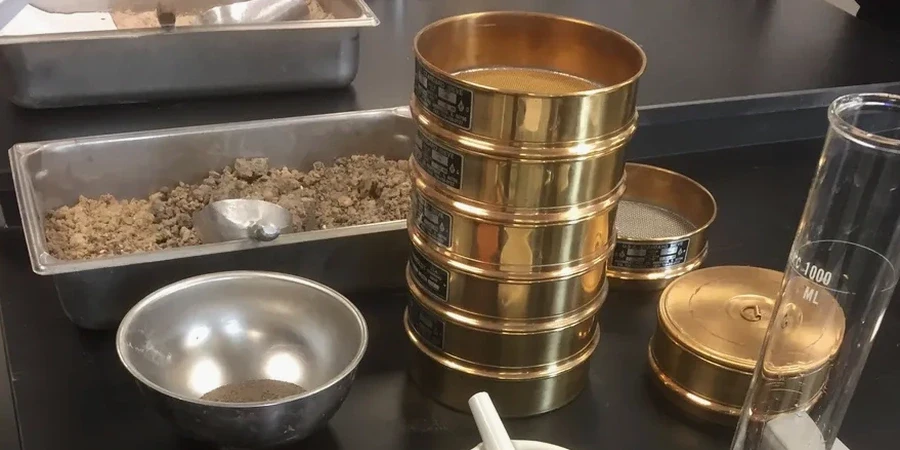
Geotechnical laboratory testing forms the investigative backbone of every safe and economical construction project in Stoke-on-Trent. This category encompasses the physical and mechanical analysis of soil and rock samples recovered from boreholes and trial pits across the city. From classifying foundation soils to determining their strength and compressibility, these controlled tests convert disturbed and undisturbed samples into reliable design parameters. In a city with such a profound industrial legacy, understanding the ground is not merely a regulatory requirement but a fundamental necessity to manage the risks posed by centuries of mining, pottery waste, and variable natural deposits.
Stoke-on-Trent's geological profile is dominated by the Carboniferous Upper and Middle Coal Measures, interbedded with sandstones, siltstones, and historically valuable seams of clay and coal. This solid geology is extensively masked by a complex mantle of glacial till, glaciofluvial sands, and alluvium along the River Trent and its tributaries. The true challenge, however, lies in the widespread artificial ground: colliery spoil, marl pit backfill, and the famous 'potteries' waste, including 'shraff' (ceramic fragments and ash). A robust grain size analysis (sieve + hydrometer) is essential to distinguish these man-made granular fills from natural cohesive tills, directly influencing foundation design and earthworks specifications.
All laboratory procedures in the UK must align with the standards set by the British Standards Institution, specifically BS 1377 for soils and, where applicable, BS EN ISO 17892 for geotechnical investigation and testing. These norms define rigorous methodologies for sample preparation, moisture content determination, and mechanical testing. For fine-grained soils prevalent in the glacial tills of North Staffordshire, determining the Atterberg limits is a critical classification step governed by these standards, quantifying the plasticity characteristics that dictate shrink-swell potential and susceptibility to volume change with seasonal weather variations.
The scope of projects requiring a comprehensive laboratory testing regime in Stoke-on-Trent is vast. Urban regeneration schemes on former pottery works or colliery sites demand thorough contamination and geotechnical assessment to validate remediation strategies. Infrastructure projects, from highway improvements on the A500 to the construction of new residential estates, rely on effective stress parameters derived from a triaxial test to calculate bearing capacity and predict settlement. Even smaller domestic extensions often require basic index testing to satisfy building control requirements, particularly where trees influence foundation depth on shrinkable clay soils.
Much of Stoke-on-Trent is underlain by artificial ground from coal mining and pottery production, including highly variable fills and contaminants. A visual inspection of a borehole log alone is insufficient. Accredited laboratory testing quantifies the engineering properties, such as compaction potential and shear strength, ensuring foundations are designed to safely manage these unpredictable man-made deposits without risking differential settlement or collapse.
The primary standard for soils is BS 1377, which details methods for classification, compaction, and shear strength tests. The BS EN ISO 17892 series is increasingly referenced for internationally harmonised procedures. These standards strictly control equipment calibration, test environment, and procedural steps to ensure the reproducibility and legal defensibility of results for UK construction projects.
A particle size distribution test separates granular soils by sieve analysis, while fine-grained soils require a hydrometer sedimentation test. The percentage passing a 63µm sieve is the key metric. This classification is complemented by Atterberg limits tests on the fine fraction, which measure plasticity and definitively distinguish silts from clays, dictating drainage and strength behaviour.
Turnaround depends entirely on the test suite's complexity. Simple classification tests like moisture content and plasticity indices can often be reported within 3 to 5 working days. However, mechanical tests requiring staged consolidation or multi-stage shearing, such as effective stress triaxial tests, require significantly longer curing and shearing phases, typically extending the programme to between 2 and 4 weeks.
We serve projects in Stoke-on-Trent and surrounding areas. More info.