GEOTECHNICAL ENGINEERING
STOKE-ON-TRENT
HomeUnderground ExcavationsGeotechnical analysis for soft soil tunnels

Geotechnical Analysis for Soft Soil Tunnels in Stoke-on-Trent

Practical geotechnics, field-tested.

LEARN MORE

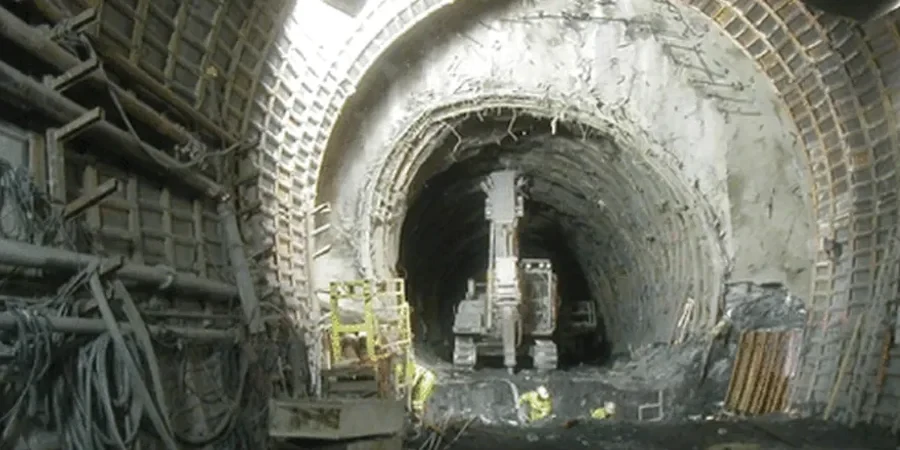
The CPT rig arrives on a low-loader, its 20-tonne weight enough to push the cone through Stoke-on-Trent's layered drift deposits without losing reaction. In this city, the ground profile rarely follows a textbook sequence. Glacial till sits over Coal Measures mudstone, but in the valleys you find pockets of soft alluvium and laminated clay that can squeeze if the tunnel depth is wrong. Our team deploys the piezocone first, measuring pore pressure response at the cone shoulder, because that data tells you whether a clay will drain or consolidate during excavation. We run dissipation tests at tunnel axis level, and the decay curve gives us the coefficient of consolidation directly, without waiting weeks for lab samples. When we encounter sand lenses, often water-bearing, the friction ratio data from the same push helps identify them before they become a face stability problem. For a city built on six towns, where the geology changes every few hundred metres, this site-specific approach is the only way to design a soft ground tunnel that stays within settlement tolerances.

In Stoke's glacial till and laminated clay sequences, consolidation behaviour governs face pressure selection, and getting the permeability wrong by one order of magnitude changes the settlement prediction entirely.
Our service areas

Methodology and scope

BS EN 1997-2:2007 and BS 5930:2015+A1:2020 form the backbone of every investigation we carry out in Stoke-on-Trent. The key requirement in soft ground is defining the undrained shear strength profile for each unit, and here the tills can be stiff while the laminated clays beneath are much weaker, a contrast that Eurocode 7 Design Approach 1 must capture through partial factors on both actions and material properties. We combine in-situ CPTu data with high-quality piston sampling, avoiding sample disturbance that would underestimate strength. Triaxial testing, consolidated undrained with pore pressure measurement, gives us the effective stress parameters needed for a coupled consolidation analysis. In the upper Coal Measures, where weathered mudstone can behave like a stiff clay, we supplement the investigation with SPT drilling to get standard penetration resistance and confirm refusal depth for any TBM cutterhead design. The resulting Ground Investigation Report follows BS 5930 descriptive logging, so every unit is classified by consistency, bedding, and discontinuity spacing, exactly what a tunnel designer needs to assign behaviour types. For the complex alluvial corridors along the River Trent and its tributaries, we often add MASW geophysics to map the bedrock surface continuously between boreholes, reducing the risk of missing a buried channel that could alter the tunnel alignment.
Geotechnical Analysis for Soft Soil Tunnels in Stoke-on-Trent
Technical reference — Stoke-on-Trent

Local geotechnical context

Stoke-on-Trent grew from six towns into a city without ever having a unified plan for its underground space. The Victorian sewer network, the abandoned mine entries from the North Staffordshire Coalfield, and the later concrete culverts that channel the Fowlea Brook all cross the shallow subsurface at different levels. We have seen projects where a tunnel drive at 15 metres depth passed directly beneath a collapsed bell pit that did not appear on any abandonment plan. The Coal Authority mining reports are essential, but they do not capture unrecorded workings from the 18th century, which are common in the Potteries. For a soft ground tunnel, the risk is not just direct intersection: dewatering caused by an open mine shaft 50 metres away can lower the groundwater table in a sand lens, triggering consolidation settlement at the surface that damages terraced housing. We map these hazards using a combination of desk study, rotary drilling through the seam horizons, and grouting design to stabilise any voids found within the zone of influence. The settlement analysis must also account for the stiffness contrast between the natural ground and the heavily industrialised fill that caps much of the city centre, because differential movement is what cracks the bottle kilns and the listed frontages.

Need a geotechnical assessment?

Reply within 24h.

Email: info@geotechnical-engineering.biz

Reference standards

BS 5930:2015+A1:2020 – Code of practice for ground investigations, BS EN 1997-1:2004 + UK NA – Eurocode 7: Geotechnical design – General rules, BS EN 1997-2:2007 + UK NA – Eurocode 7: Ground investigation and testing, BS 1377-6:1990 – Methods of test for soils: Consolidation in oedometer, BS 1377-8:1990 – Triaxial compression tests (CIU, CAU), CIRIA C760 – Guidance on embedded retaining wall design for soft ground

Technical data

ParameterTypical value
Ground investigation standardBS 5930:2015+A1:2020
Geotechnical design codeBS EN 1997-1:2004 + UK National Annex
In-situ testing methodCPTu with pore pressure dissipation (u2)
Sampling technique for soft clayThin-walled piston sampler (Shelby)
Key design parameter for tunnellingUndrained shear strength (cu) profile
Consolidation testing standardBS 1377-6:1990 oedometer
Triaxial test type for effective stressCIU with pore pressure measurement (BS 1377-8)
Typical target depth in Stoke valleys20 to 35 m below ground level

Frequently asked questions

How much does a geotechnical investigation for a soft ground tunnel cost in Stoke-on-Trent?

For a tunnel project in Stoke-on-Trent, the investigation cost depends on the alignment length, the number of CPTu and borehole positions, and the depth to tunnel axis. A typical scope ranges from £2,990 for a targeted single-borehole study with lab testing to around £12,180 for a multi-point campaign with full triaxial and consolidation suites. Each quote is project-specific because the geology changes so much across the city's six towns.

What consolidation parameters do I need from the lab for a soft ground tunnel design in Stoke?

You need the coefficient of consolidation (cv) from incremental load oedometer tests on undisturbed samples, the compression index (Cc) and recompression index (Cr), and the preconsolidation pressure (pc') from the e-log sigma' curve. For Stoke's laminated clays, we also recommend running tests on both horizontal and vertical specimens because the permeability anisotropy can exceed a ratio of 5, which significantly affects the time rate of surface settlement above the tunnel.

How do you handle the risk of old mine workings beneath the tunnel alignment in the Potteries?

We start with a detailed desk study including Coal Authority reports, geological mapping, and historical Ordnance Survey overlays. Then we drill rotary boreholes through the full Coal Measures sequence at intervals along the alignment, logging for voids, broken ground, and ochreous staining that indicates old workings. If we find voids within the zone of influence above the tunnel crown, we design a low-mobility grouting programme to fill them and reduce the risk of sudden collapse or dewatering during the drive.

Location and service area

We serve projects in Stoke-on-Trent and surrounding areas.

View larger map