GEOTECHNICAL ENGINEERING
STOKE-ON-TRENT
HomeInvestigationSPT (Standard Penetration Test)

SPT (Standard Penetration Test) in Stoke-on-Trent: Reliable Ground Data

Practical geotechnics, field-tested.

LEARN MORE

The drift geology beneath Stoke-on-Trent presents a real mix of glacial till, sand and gravel pockets, and weathered mudstone from the Upper Carboniferous Coal Measures—sometimes within the same borehole log. We have worked on sites in Hanley and Longton where the SPT N-value jumps from 8 to refusal in less than a metre, reflecting the erratic bedrock surface typical of the Potteries. Standard Penetration Testing remains the most practical way to profile strength variability in these conditions, providing split-spoon samples that our lab in the West Midlands processes for classification and shear strength correlation. When the drift cover is thin and fill layers are encountered, we often combine SPT data with test pits to map anthropogenic material thickness that boreholes alone can miss.

A single SPT refusal at 2.4 m in Stoke-on-Trent can shift a foundation design from pad footings to driven piles—and save the contractor a costly redesign later.
Our service areas

Methodology and scope

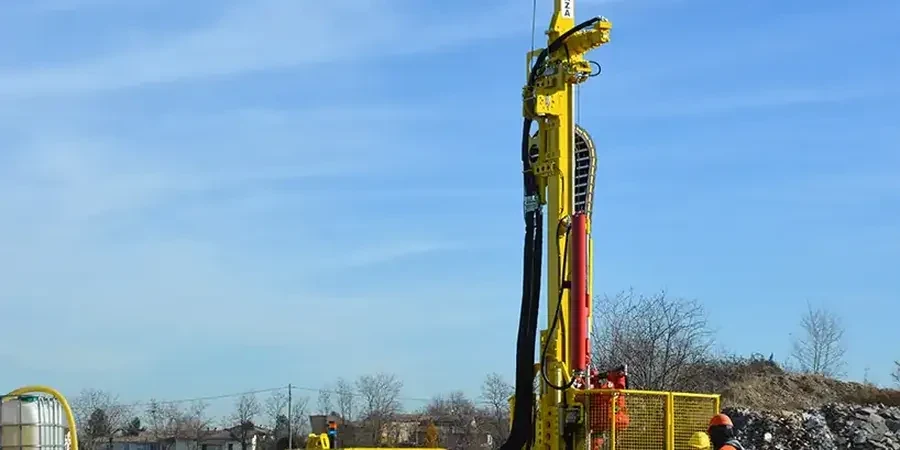
The SPT rig we mobilise around Stoke-on-Trent is a tracked dynamic penetrometer with an automatic trip hammer calibrated to BS EN ISO 22476-3, delivering 60% energy transfer efficiency for raw N60 conversion. The setup uses AW rods and a standard 51 mm split-spoon sampler driven over 300 mm increments after a 150 mm seating drive. On sloping sites near the Trent & Mersey Canal corridor, where access is tight and headroom limited, we deploy compact rubber-tracked rigs that still achieve the required 760 mm stroke height. Each test records blow counts for every 75 mm of penetration, and we log refusal at 50 blows over any single increment—critical for identifying the mudstone bedrock contact that governs foundation depth. In cohesive layers, we pair SPT readings with Atterberg limits on recovered samples to refine undrained shear strength estimates for shallow footing design.
SPT (Standard Penetration Test) in Stoke-on-Trent: Reliable Ground Data
Technical reference — Stoke-on-Trent

Local geotechnical context

In Stoke-on-Trent, we frequently see boreholes terminated prematurely in weathered mudstone that was misidentified as refusal in glacial boulders—only for trial pits later to reveal a metre of soft clay beneath. The Coal Measures shale weathers to a stiff grey-brown clay that can fool a driller relying solely on blow count. We log every sample carefully: refusal in dark, fissile fragments signals bedrock; refusal in rounded cobbles with a sandy matrix points to glacial drift. Another local hazard is old mine workings beneath the city, particularly in the Etruria and Fenton areas. Unrecorded shallow shafts collapse slowly, creating loosened ground where SPT N-values drop below 5 at depth—a warning sign we flag immediately to the structural engineer.

Need a geotechnical assessment?

Reply within 24h.

Email: contact@geotechnical-engineering.biz

Reference standards

BS 5930:2015+A1:2020 - Code of practice for ground investigations, BS EN ISO 22476-3:2005 - Geotechnical investigation and testing - Field testing - Standard penetration test, BS EN 1997-2:2007 - Eurocode 7 - Geotechnical design - Ground investigation and testing, UK National Annex to BS EN 1997-2

Technical data

ParameterTypical value
Standard appliedBS EN ISO 22476-3:2005
Hammer typeAutomatic trip, 63.5 kg
Drop height760 mm
SamplerStandard split-spoon, 51 mm OD
Drive increments150 mm seating + 3 × 75 mm
N-value reportingN30 (last 300 mm) or N60 corrected
Refusal criterion50 blows per 150 mm increment

Frequently asked questions

How much does an SPT borehole cost in Stoke-on-Trent?

A single SPT borehole to 10 m depth, including mobilisation within Stoke-on-Trent, site attendance by a driller and geotechnical engineer, full logging, and a factual report, typically falls between £380 and £540 plus VAT. Deeper boreholes, multiple locations, or combined testing (permeability, sampling) will increase the total. We provide a fixed-price quote after reviewing the site location and access constraints.

How deep do you need to drill SPT boreholes in Stoke-on-Trent for a house extension?

For a typical two-storey extension on glacial till, we recommend boreholes to at least 6 m depth, or 3 m below the proposed foundation level, whichever is deeper. If the Coal Measures mudstone is encountered before 6 m, we core 1.5 m into competent rock to prove it is not a boulder. The local building control authority in Stoke-on-Trent generally accepts SPT-based bearing pressures for shallow foundations when supported by a factual ground investigation report.

What is the difference between N-value and N60 in an SPT report?

The raw N-value is the total blow count for the last 300 mm of penetration using the hammer setup on site. N60 is the N-value corrected to 60% of the theoretical free-fall energy, which accounts for hammer efficiency, rod length, and borehole diameter. Our automatic trip hammer delivers approximately 60% efficiency, so N60 is close to the raw value, but we still apply corrections per BS EN ISO 22476-3 to ensure the data is comparable with published correlations for relative density and friction angle.

Location and service area

We serve projects across Stoke-on-Trent and its metropolitan area.

View larger map