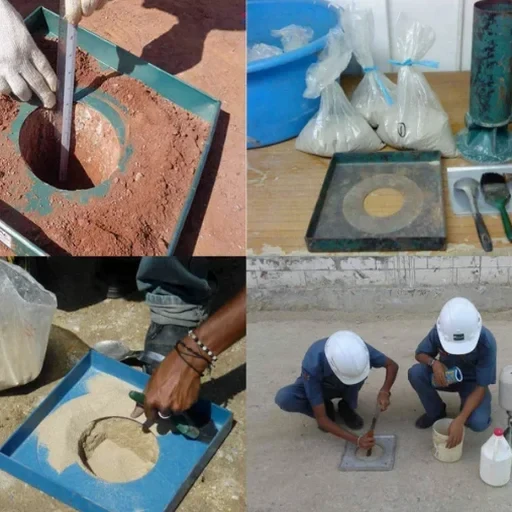
One of the most common mistakes on road projects across Stoke-on-Trent is treating the subgrade as a uniform material, overlooking the legacy of abandoned mine workings and heterogeneous fill that characterises the Potteries region. A flexible pavement derives its structural capacity from load distribution through the asphalt and granular layers, which means that any differential settlement in the subgrade immediately translates into surface cracking and premature rutting. The local drift geology often presents a mix of glacial till and made ground overlying the Coal Measures, creating conditions where a standard catalogue design from outside the area will almost certainly fail within the first few freeze-thaw cycles. We approach every scheme by first defining the long-term stiffness modulus of the formation through a combination of in-situ testing and laboratory classification, because without a reliable subgrade CBR or resilient modulus, even the most meticulously specified bituminous layers cannot compensate for a weak foundation. Road engineers in Stoke-on-Trent have learned that cutting corners on the pavement foundation investigation is a false economy, particularly where the underlying ground conceals undocumented shafts or pockets of compressible industrial waste.
A flexible pavement is only as strong as its weakest subgrade metre—in Stoke-on-Trent’s mining-affected ground, that metre must be investigated, not assumed.