GEOTECHNICAL ENGINEERING
STOKE-ON-TRENT
HomeGround improvementVibrocompaction design

Vibrocompaction Design for Ground Improvement in Stoke-on-Trent

Practical geotechnics, field-tested.

LEARN MORE

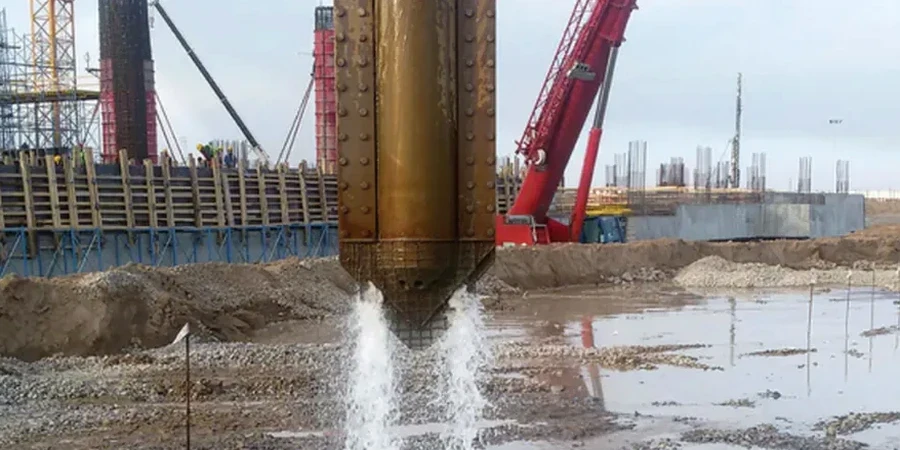
The legacy of deep coal mining and centuries of pottery manufacture has left Stoke-on-Trent with one of the most complex near-surface geologies in the Midlands. In our experience, the combination of colliery spoil, historic clay pit backfill, and pockets of soft alluvium along the Trent creates a loose, heterogeneous ground profile that defies standard compaction methods. That is precisely where deep vibratory compaction becomes the rational first choice: it densifies granular fills and sands at depth without excavation, turning problematic made ground into a competent bearing stratum. On the sloping sites that characterise the Six Towns, we often pair vibro design with a prior MASW survey to map shear-wave velocity before and after treatment, giving the client a measurable performance benchmark.

On brownfield sites across the Potteries, a well-calibrated vibrocompaction grid can raise relative density from below 45 % to over 75 % within two shifts per sector.

Our service areas

Methodology and scope

Stoke-on-Trent sits at roughly 100 to 200 metres above ordnance datum, with a post-industrial population of approximately 375,000 across the federation of towns. What the topography hides is an intricate patchwork of unrecorded shafts, marl workings, and tipped pottery waste — materials that can collapse or differentially settle under load. Our vibrocompaction design workflow follows BS EN 1997-2 ground investigation requirements: we first characterise the fill with dynamic probing or CPT, then establish a grid of compaction points with spacing derived from Priebe’s method and back-calculated target SPT N-values. The design brief always includes a minimum relative density of 70 % and a verification programme, typically using zone load tests or post-treatment CPT. For fine-grained horizons interbedded with the granular fill, we evaluate whether stone columns offer a more effective reinforcement mechanism, and the decision hinges on the fines content measured through wash-sieve analysis.
Vibrocompaction Design for Ground Improvement in Stoke-on-Trent
Technical reference — Stoke-on-Trent

Local geotechnical context

BS 5930:2015+A1:2020 and the CDM 2015 regulations place a clear duty on designers to address foreseeable ground hazards on former mining land. In Stoke-on-Trent the principal risk is not just loose fill but the presence of uncharted mine entries that can act as conduits for vibro-induced collapse or sudden loss of backfill volume. A desk study augmented by coal authority records and a targeted CPT investigation is therefore mandatory before any vibrator touches the ground. We also assess the proximity of neighbouring terraced properties — typical of Burslem and Hanley — to limit peak particle velocities below 5 mm/s, protecting fragile brickwork from vibration damage. Liquefaction is not a dominant concern in the West Midlands seismic setting, but cyclic mobility in saturated sand lenses within the fill can still trigger settlement under heavy plant loading.

Need a geotechnical assessment?

Reply within 24h.

Email: info@geotechnical-engineering.biz

Reference standards

BS EN 1997-2:2007 – Ground investigation and testing, BS 5930:2015+A1:2020 – Code of practice for ground investigations, BRE FB 75 – Specifying vibro stone columns and vibrocompaction, CDM 2015 – Construction (Design and Management) Regulations

Technical data

ParameterTypical value
Target relative density (Dr)≥ 70 % post-treatment
Suitable soil typeGranular fills, sands, gravels with fines < 15 %
Maximum treatable depthUp to 25 m with leader-mounted vibrator
Design standardBS EN 1997-2, BRE FB 75
Verification methodPre/post CPT, zone load test, cross-hole seismic
Typical grid patternTriangular spacing 2.5–4.0 m c/c
Vibrator power class130–180 kW electric/hydraulic

Frequently asked questions

What ground conditions in Stoke-on-Trent make vibrocompaction suitable?

Sites underlain by granular colliery spoil, sand-and-gravel backfill, or loose natural sands with a fines content below 15 % respond best. Where the fill contains more than 20 % silt or clay, vibrocompaction alone is rarely effective and we would advise considering stone columns instead. The depth to the natural strata across the Potteries varies widely — from 2 m near the Trent floodplain to over 15 m on former pit mounds — so a targeted CPT profile is essential to confirm treatability before committing to a design.

How much does a vibrocompaction design package cost?

The design phase, including desk study, trial compaction planning, and the final method statement with verification schedule, typically falls between £1.130 and £3.930, depending on the number of trial sectors and the complexity of the coal authority review. This range covers the engineering input only; the execution and verification testing are quoted separately based on the grid area and depth.

How do you verify the compaction achieved without expensive coring?

We rely primarily on CPT before and after treatment — cone resistance gives a continuous, repeatable profile that correlates directly with relative density. On larger schemes we add cross-hole seismic or surface-wave testing to measure the increase in shear-wave velocity across the full depth of treatment. Zone load tests, using a plate at the formation level, provide a direct bearing-capacity figure that satisfies NHBC and building-control reviewers.

Location and service area

We serve projects in Stoke-on-Trent and surrounding areas.

View larger map